
The Shift Is Already Underway
Your customers aren’t searching the web like they used to. They’re asking Claude, ChatGPT, and Gemini what to buy. They’re bouncing between AI assistants to compare options. Some are letting agents handle the entire purchase workflow, from discovery through checkout, while they do something more important with their time.
This isn’t hypothetical. It’s happening now. And it’s not the same as SEO optimization or traditional paid search.
This is agentic commerce, a fundamental rewiring of how products get discovered, evaluated, and purchased in a world where AI agents mediate the entire customer journey.
If you’re running an eCommerce store or managing product strategy in this space, you need to understand what’s changing, why it matters, and how to compete in it.
What Is Agentic Commerce?
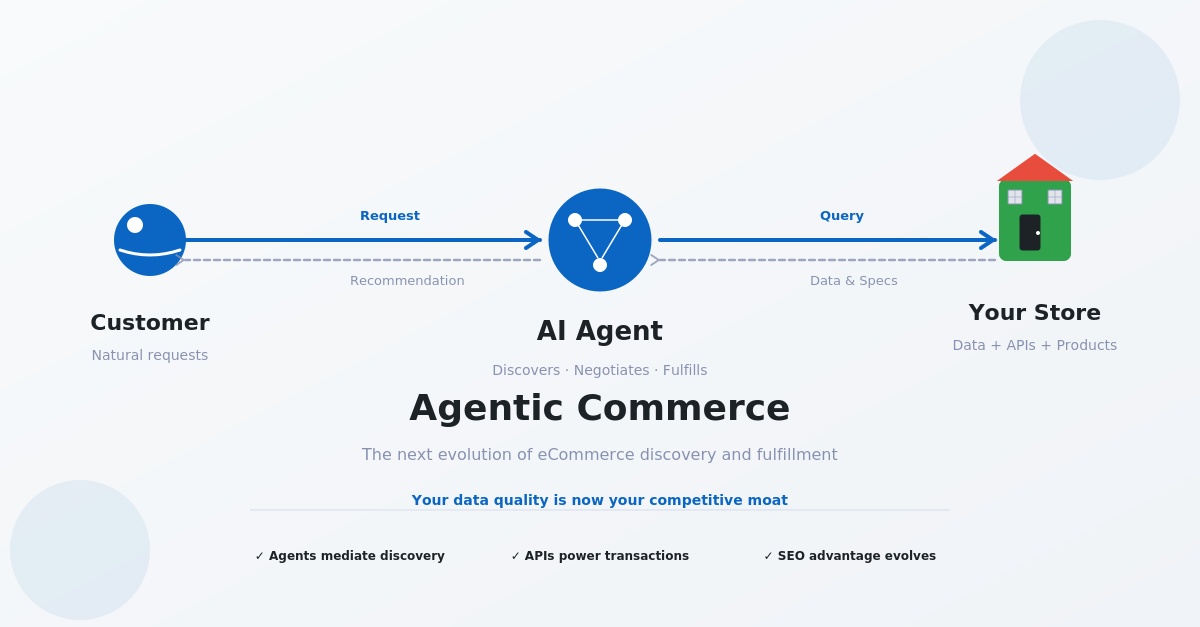
Agentic commerce is the shift from consumers visiting your store to AI agents acting on behalf of consumers within your store (or your product data ecosystem).
Unlike traditional eCommerce, where you own the storefront and control the customer experience, agentic commerce inverts that relationship. The agent, not your site, becomes the interface. Your role shifts from “destination” to “capability provider.”
Three patterns define the change:
1. Agent-Mediated Discovery
Customers tell an agent what they need. The agent queries your catalog (via API, structured data, or integration) to surface matching products. Your SEO, category hierarchy, and product taxonomy become inputs to the agent’s reasoning, not destinations for human browsers.
Example: “Find me a docking station under $150 that works with Mac and supports four displays.” The agent evaluates your structured product data, compares specs, and recommends options, all without the customer ever landing on your site.
2. Agentic Negotiation & Fulfillment
Agents don’t just browse. They execute transactions, manage returns, track orders, and resolve issues autonomously. Your API contracts and order management systems become part of the customer service layer.
Example: An agent handles post-purchase issues by autonomously checking order status, initiating returns, and arranging replacements, reducing your support load while improving resolution speed.
3. First-Party Data as Competitive Moat
Because agents operate at scale across vendors, the stores with the richest, cleanest, most accessible product data, structured specs, inventory real-time, customer reviews, variant clarity, will rank highest in agent recommendations. Traditional SEO advantages (backlinks, domain authority) become less relevant. Data quality becomes everything.
Why This Matters Now
Three converging forces make agentic commerce inevitable:
1. LLMs Have Gotten Good at Multi-Step Reasoning
Claude, GPT-4, and Gemini can now reliably decompose complex customer requests (budget, specs, availability, shipping) and match them to product data. They can also execute sequences, browse, filter, checkout, status check, without human intervention.
2. AI Assistants Are Becoming the Default Interface
Adoption of ChatGPT, Claude via Claude.ai, and Gemini has crossed inflection points in developed markets. For many users, the AI chat window is now the primary shopping interface, not Google or your homepage.
3. Composable Architecture Is Becoming Standard
Magento PWA, composable eCommerce platforms, and headless implementations have made it feasible to expose your store logic (search, cart, checkout) via API. Your architecture is ready for agents, even if you haven’t built the agent integration yet.
The Competitive Disadvantage of Waiting
If you’re not in agentic commerce yet, you’re losing visibility in a high-intent channel that skips your paid search, SEO, and brand campaigns entirely.
What happens when you’re not ready:
- Agents can’t access your products. Agents query publicly available data: your website, marketplace listings, spec sheets. If your product data is unstructured, inconsistent, or locked behind login walls, agents can’t confidently include you in recommendations.
- Your competitors get the recommendation. A competitor with cleaner specs, real-time inventory APIs, and structured data will rank higher in agent outputs. Same customer intent. Different winner.
- You lose pricing leverage. In traditional eCommerce, search volume and conversion rate are in your control. In agentic commerce, agents optimize for value (price + specs + trust), not margin. Undercutting becomes the default strategy.
- You can’t build loyalty. Agents are neutral. They don’t care about your brand story, email list, or loyalty program. Every interaction is transactional.
The stores that move first on agentic commerce will have a 12–18-month head start on data quality, agent integrations, and market share.
How Agentic Commerce Differs from What You’re Already Doing
vs. Generative Engine Optimization (GEO)
GEO is about getting your content cited in AI-generated answers. It’s one-directional: you publish, AI reads, customer sees your mention. Agentic commerce is two-directional: agents query your APIs, execute on your behalf, and drive transactions directly.
GEO gets you visibility. Agentic commerce gets you revenue.
vs. Traditional SEO
SEO optimizes for human search intent and crawler indexation. Agentic commerce optimizes for agent reasoning and API accessibility. Your keyword strategy, backlink profile, and on-page optimization still matter, they feed into agent context, but they’re not the bottleneck anymore. Data completeness and API performance are.
vs. Marketplace Models (Amazon, etc.)
On marketplaces, you’re one of thousands of sellers competing on price and reviews. You have no customer relationship. In agentic commerce, you keep your customer relationship and expose your catalog to agents. You’re not a marketplace seller; you’re a data partner.
The Bottom Line
Agentic commerce is not a future trend. It’s a present reality, happening faster than most eCommerce leaders expect. Customers are already letting AI agents handle product research and purchasing. The question isn’t whether it will happen, it’s when your store will be ready for it.
The stores that move first on data quality, API exposure, and agent partnerships will command premium positioning in agent recommendations. The rest will compete on price, losing margin to more prepared rivals.
The time to act is now.
Have questions about implementing agentic commerce for your platform? Let’s talk.
